
![[img]](https://epub.uni-regensburg.de/31532/1/Sugar_CantonS_figshare_01.png)
| Download ( Bild (PNG) | 802kB) | Lizenz: Creative Commons Namensnennung 4.0 International |

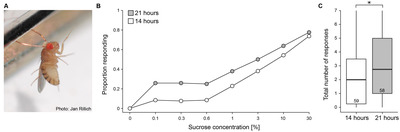
Drosophila sugar response is increased by starvation duration and sucrose concentration in a locomotion-independent proboscis extension test
Bild
Damrau, Christine, Brembs, Björn und Colomb, Julien (2014) Drosophila sugar response is increased by starvation duration and sucrose concentration in a locomotion-independent proboscis extension test. [Bild]DOI zum Zitieren dieses Dokuments: 10.5283/epub.31532
Zusammenfassung
A. Proboscis extension response assay. One to two days old CantonS flies of mixed gender were starved for the indicated time with ad libitum access to water. Four hours before testing, they were glued to a copper hook between head and thorax. For the test, the hook was fixed to clamp which was attached to a rack. In this locomotion-independent assay, all tarsi can be stimulated with no stress or ...
A. Proboscis extension response assay. One to two days old CantonS flies of mixed gender were starved for the indicated time with ad libitum access to water. Four hours before testing, they were glued to a copper hook between head and thorax. For the test, the hook was fixed to clamp which was attached to a rack. In this locomotion-independent assay, all tarsi can be stimulated with no stress or pressure on abdomen by a serial dilution of seven increasing sucrose concentrations (0%, 0.1%, 0.3%, 0.6%, 1%, 3%, 10%, 30%, 30% to labellum).
B. The proportion of flies that extended proboscis after being stimulated at all the tarsi. Flies either responding to the first (water) or not responding to the last 30% to the labellum were excluded from the data analysis. The proportion of responding flies increases not only with increasing sucrose concentration but also with increasing starvation time of 21 hours compared to 14 hours.
C. The response index is significantly higher after 21 hours compared to 14 hours of starvation indicated by asterisk (Wilcoxon rank sum test, p < 0.05) and was calculated by summing the positive proboscis extension responses to all the seven stimulations and are illustrated as medians (bar), the 75%- and 25%-quartiles (box) and the total data range (whiskers). Numbers inside the boxes indicate sample sizes.
Alternative Links zum Volltext
Beteiligte Einrichtungen
Details
| Dokumentenart | Bild | ||||
| Datum | 5 September 2014 | ||||
| Veröffentlichungsdatum | 27 Mrz 2015 12:42 | ||||
| Institutionen | Biologie und Vorklinische Medizin > Institut für Zoologie > Neurogenetik (Prof. Dr. Björn Brembs) | ||||
| Identifikationsnummer |
| ||||
| Stichwörter / Keywords | Drosophila, proboscis-extension, starvation, method, sucrose preference test | ||||
| Dewey-Dezimal-Klassifikation | 500 Naturwissenschaften und Mathematik > 570 Biowissenschaften, Biologie 500 Naturwissenschaften und Mathematik > 590 Tiere (Zoologie) | ||||
| Status | Veröffentlicht | ||||
| Begutachtet | Unbekannt / Keine Angabe | ||||
| An der Universität Regensburg entstanden | Unbekannt / Keine Angabe | ||||
| URN der UB Regensburg | urn:nbn:de:bvb:355-epub-315322 | ||||
| Dokumenten-ID | 31532 |
Bibliographische Daten exportieren
Nur für Besitzer und Autoren: Kontrollseite des Eintrags
 Downloadstatistik
 Downloadstatistik